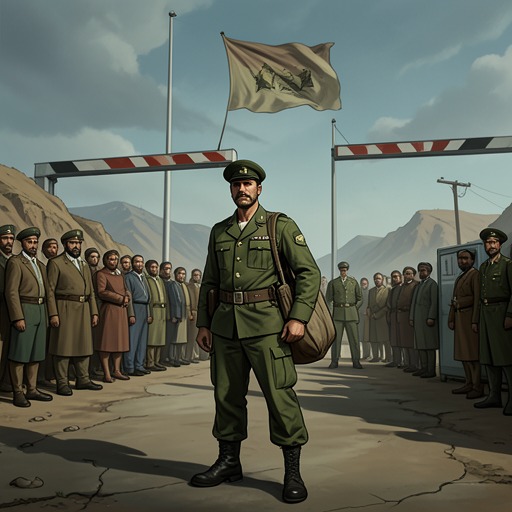
Mauritania’s constitutional principle of non-extradition of citizens
Guantanamo DiaryMauritania’s constitutional principle of non-extradition of citizens becomes concrete in Mohamedou Ould Slahi’s account of being secretly handed over to foreign authorities. His transfer to Jordan on Mauritanian Independence Day, without a disclosed evidentiary case or extradition proceedings, turns a constitutional safeguard into a test of whether a state can protect its own citizens when cooperation with the United States takes precedence over ordinary legal process.
The Rule and Slahi’s Claim
Slahi describes the constitution as forbidding the extradition of Mauritanian citizens, and argues that suspicion alone could not justify delivering him to the United States. In his account, Mauritania should have required evidence implicating him and, if there were grounds for a case, prosecuted him under Mauritanian criminal law. He points to Germany’s treatment of its own citizens suspected of involvement in the September 11 attacks as a contrasting example of domestic prosecution rather than surrender. These are Slahi’s stated legal and political arguments; the account does not reproduce the constitutional text or a judicial ruling on its application.
His criticism rests on a distinction between being captured abroad and being taken from home. He accepts that his government might not be responsible if he had chosen to travel to Afghanistan and been captured there. What he rejects is his own government’s participation in removing him from Mauritanian territory and placing him in United States custody without the procedures he believed the constitution required. He says the Mauritanian government had no incriminating evidence to provide and should not have treated a request from abroad as a substitute for a domestic legal process.
Arrests and an Interrupted Ordinary Life
The constitutional issue emerged against a history of repeated questioning. In January 2000, after flying from Canada to Senegal, Slahi and his brothers were seized and questioned about the Millennium Plot. An American took photographs; Slahi was then flown to Mauritania and questioned further. The timeline reproduced in James Robertson’s declassified 2010 order records another interrogation about the plot in February. Between his Mauritanian arrests, however, Slahi worked in computer and electronics jobs, first for a medical-supply and Internet-services company and then for a family-owned import business.
After an earlier detention, Slahi feared that the terrorism suspicion would cost him his job. A senior Mauritanian intelligence official called his employer in his presence, said he had been questioned and was cleared to return, and the employer took him back. A little over a month later, Slahi’s work brought him to the Presidential Palace of Mauritania, where he spent a day preparing a bid to upgrade President Maaouya Ould Sid’Ahmed Taya’s telephone and computer systems. When he returned home, police came again. He went voluntarily to headquarters in his own car, telling his mother he would be back soon. This time, he disappeared.
The Independence Day Transfer
Slahi says he spent seven days in Mauritanian custody without family visits; his family was not told where he was. On November 28, 2001, he was informed that he would be sent to Jordan. The date was Mauritanian Independence Day, marking independence from France in 1960. For Slahi, the coincidence sharpened the contradiction: the state celebrating its independence was, on that same day, surrendering one of its own citizens to foreign custody.
The night before the transfer, guards let him watch a parade moving from downtown toward the Presidential Palace. Schoolboys carried lighted candles alongside the bands. The scene recalled Slahi’s own participation as a schoolboy nineteen years earlier, when he had watched the parade as a celebration of his country’s birth. In retrospect, the public ceremony of national independence stood beside a private transfer that, in his view, showed the limits of that independence. The account describes the handover as a multilateral arrangement involving Mauritania, the United States, and Jordan, rather than a proceeding in which Slahi could contest the transfer before a court.
Legal Safeguard and Security Cooperation
Slahi places primary blame on his own government, even while describing the United States as the force driving the process. He says Mauritanian agents had encouraged him to flee, but he stayed because his family believed the assurances that he had done nothing wrong and urged him to answer official requests. His choice to report voluntarily makes the subsequent disappearance especially stark: the state’s assurances of lawful questioning gave way to a transfer his family could not monitor and that Slahi says violated the constitution.
The broader account situates Mauritania’s cooperation within a secret United States detention and interrogation program involving foreign partners. In early 2002, Slahi’s family did not know he was in Jordan. A later CIA inspector general report described the agency’s interest in keeping isolated detainees who might otherwise disclose the circumstances of their detention, an indication of the secrecy surrounding the wider system. Slahi also recounts that, after his transfer, an interrogator presented him with an obviously forged Department of Defense letter alleging his involvement in the Millennium attack and recruitment of September 11 hijackers, and threatening his mother. That episode does not establish what evidence Mauritanian officials possessed when they transferred him; it does underscore why Slahi’s demand for evidence and legal process matters to the story.
The principle’s significance in the account lies in the distance between constitutional protection and its practical enforcement. Slahi recalls that President Ould Taya wished he had not had to turn him over, and suggests that the decision later cost the president his office; the narrative presents this as Slahi’s retrospective interpretation, not as an independently established cause. The transfer nonetheless gives the rule a precise human consequence: a citizen who had been told he was free to return to work was taken from his country without the public process he believed its constitution guaranteed.